Two of us, Marie Naka and Jessica Cruz, worked together to design and teach a hands-on inquiry-based basic science lesson about memory because we wanted to find an engaging, relatable topic for our lesson that would allow us to continue addressing multiple needs and grade levels of this mixed-age after school program.
Classroom Context
This is the third lesson out of three that was taught at Trinity College Boys & Girls Club to a group of about 10 elementary and middle schoolers from various schools in Hartford. The students are all learning different things in school and, due to their different ages, have different levels of ability and interest. In this lesson, we aimed to engage all students despite the variety in demographics. While students had not expressed direct interest in the topic at hand, we thought it would be engaging because it isn’t material that is often covered at a middle school level, and everyone can relate to it.
Student Learning Objectives
- Students will relate the prioritization of memories to salient information.
- Students will construct a hypothesis about how information and experiences become memories (NGSS MS-LS1-8).
Guiding Question
How and when do memories stick?
Learning Activities
Launch
To start the lesson, we asked the students to pretend that they were observers of a car crash and to pay attention to the details. With that in mind, we played this video two times before discussing the following as a class:
- What color was the car that got hit? (gray/silver)
- What side of the video was the car that got hit coming from? (right side)
- Did you see the billboard in the background? (there isn’t one)
- What color was the sign on the nearest building? (blue and white)
Then, we showed the video again to see how students did.
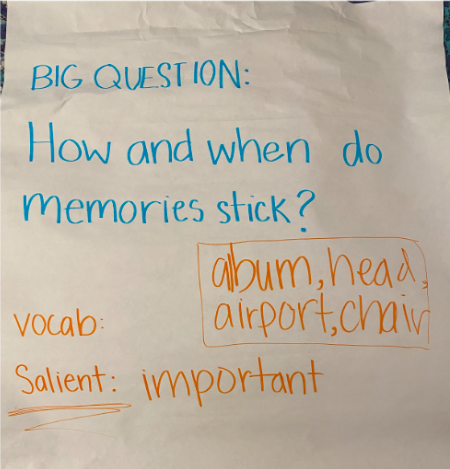
To note, it was likely that students would not answer all of these correctly; memory is susceptible to manipulation. When there were some inaccuracies with answers and their memory of the video, we briefly discussed that we paid more attention to the details of the car crash than those of the scene behind it. To understand why this happens, we revealed the Guiding Question on a poster (Figure 1).
In addition to the big question, we shared a new vocab word, salient (meaning important), on the poster to be further discussed and used throughout the lesson.
Memory Strategies Competition
In transition to our next activity, we discussed that the car crash in the video was salient and that’s why we paid so much attention to it, but sometimes we need to remember information that isn’t salient, like when we’re studying for school. Luckily, there are ways for us to allow our brains to make unnoticeable information into noticeable (salient) information. With this, we started this activity with an example of a list of words (Figure 2) for us to remember; pointing out that the words in this list alone are somewhat unimportant/not salient.
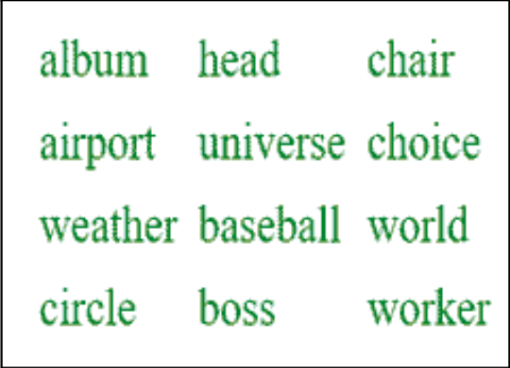
To seemingly make them more important, we introduced two memory strategies that could help us with memorizing them:
- Visual Method: Visualize a scene that links as many words from the words from the lists and describe it.
- Example: In the room there is an album on a chair with an airport on the front of it. Through the window, my boss and another worker are playing baseball and running in circles like the world around the sun in the universe.
- Self-Reference Method: Relate the words to yourself
- Example: My mom is the boss of her company. I go to the airport a lot. The weather in Connecticut makes me sad. My brother likes baseball.
Then, we instructed the students to choose one of the strategies, or one of their own that they must explain after, and gave them a small paper (Figure 3) of a list of words to memorize.
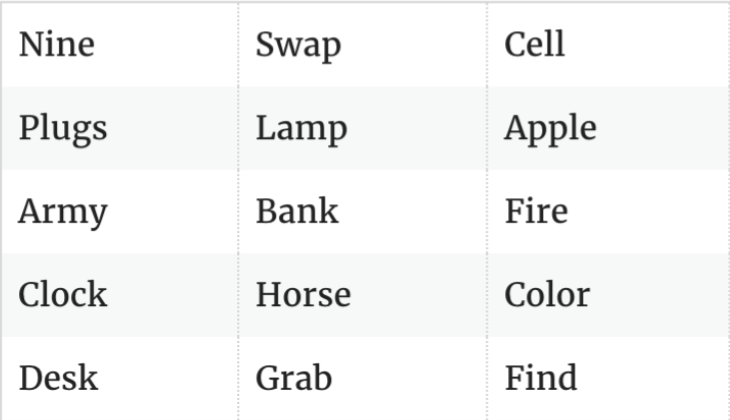
We gave the students 5 minutes to practice memorizing, then took the list of words away. Then, we informed them that whoever could remember the most words would get a prize (revealed at the end; the top three winners got a small notebook or chocolate). Next, using another piece of paper, they had two minutes to write down as many words as they could remember. Afterwards, we read out the list of words and instructed students to write a check next to each word they correctly listed and count how many they got. Finally, students were asked to raise their hand if they got all 15 words right, 14 correctly, 13, and so on until 9 or less words.
Mapping Out Memory
Moving into our next activity, we introduced the field of science called psychology. Without formally describing psychology, we asked students to put their psychologist hats on and work with a partner or individually to think about the memory activities and describe how they thought memory worked based on the activities we’d done. Then, as a class, we discussed this and moved into our closing discussion.
Closing
To put everything together, we discussed what the students wrote, and the Guiding Question, “How and when do memories stick?” Following this, we asked the following questions to think about real world applications:
- Did you like any of the memory strategies? If so, which one and would you use it in the future?
- Thinking about what we learned, how might you change the way you study?
Challenging Inequity
Our lesson was taught to a mix of students across grade levels, ages, and schools. It is centered around a topic that impacts all students no matter their knowledge or skill levels, following the idea of cultural competence in Culturally Relevant Pedagogy. The accessibility of the lesson to different groups of students falls into the principles of Universal Design for Learning.
Assessment
Before Teaching
Before teaching our lesson, our plan was to assess learning through the discussions we would have with the students throughout the lesson, from the memory experiment activity, to the share-out after the mapping activity, and finally, to the discussion at the end where we revisit the big question and look into real-world applications of what we’d gone over in the lesson. Additionally, we planned to collect the maps they would make of how they thought memory worked, capturing their learning on paper.
After Teaching
Our assessment didn’t quite go as planned because the students didn’t always know how to participate in the discussions, and they were confused by the memory mapping activity. Without clearer instructions, kids weren’t always sure what they were supposed to be putting on the paper. Even though we told them to work in groups, a lot of students worked alone anyway, and since we’d told them they could draw or write, whichever worked better for them, everyone just chose to write. Here are some examples of what they wrote.
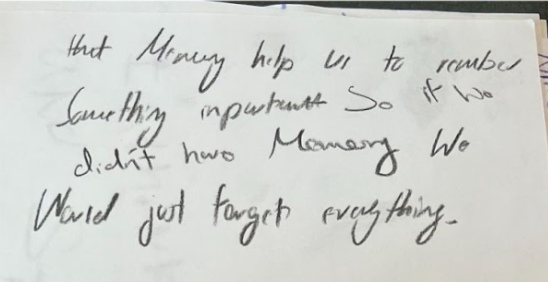
Grammar corrected for ease of understanding, the student wrote the following: “Memory helps us to remember something important, so if we didn’t have memory, we would just forget everything.”
While this is certainly true, it’s not what we wanted students to focus on here. Our minimal directions were intended to create flexibility for students to express in many different ways how they thought memory worked, but we didn’t give them enough information beforehand to even consider how the process might look. This led to confusion, and the student wrote down what they knew already, which makes sense. Students might have been able to engage more fully if they had been given different steps of how memory works and asked to piece them together.
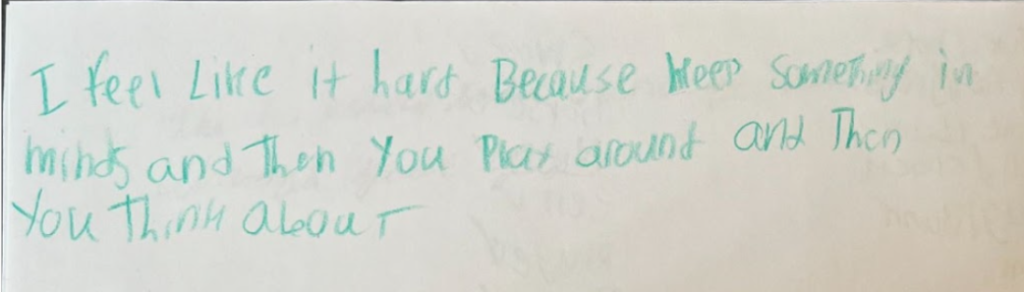
This student said: “I feel like [memory is] hard because you keep something in your mind, and then you play around and then you think about [other things].”
At first it seems like this student also didn’t respond to the activity the way we’d envisioned, but upon closer inspection, the explanation here does start to poke at the wanted ideas. Thinking about the memory strategies activity we had just completed, he starts with the statement that memory is hard. From there, he considers why. He thought about his own life, bringing in the concept of play and paying attention to that, which he connected to forgetting other things. It isn’t necessarily a spotless diagram of the way memory works, but it is a rudimentary understanding of what can impact our memories (the guiding question) by way of a clear and specific example that relates to the student’s personal experiences. When we discussed our memory maps with the class (see the video below), he brought up his point to share with his peers.
Figure 6. Student 2 shares his ideas.
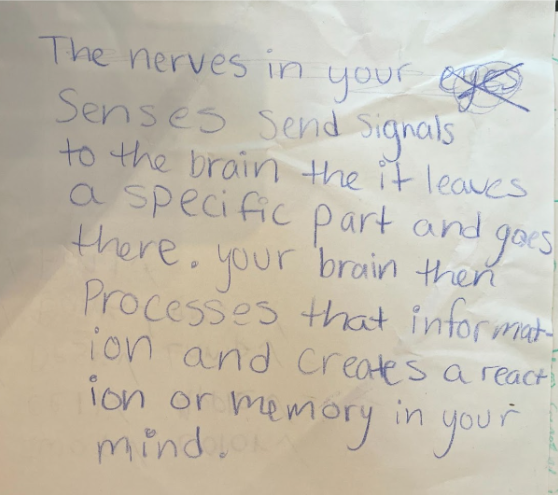
This student and his partner came up with this explanation: “The nerves in your senses send signals to the brain, then it leaves a specific part and goes there. Your brain then processes that information and creates a reaction or memory in your mind.”
Originally, the students here had put “eyes,” making connections to their classes at school. Then one of them realized that you don’t only experience things through seeing, so Marie, who was sitting with them, suggested senses as a replacement word. They continued with their thoughts, saying that your senses report back to your brain, and then they said that the memory is created from your brain processing the information.
This is exactly what we were hoping to see; the students in this example used the information they had available to them to make sense of how memory works in a basic way. They don’t get to all the ins and outs of memory, but we didn’t ask them to do so. This work shows that the students here were thinking about the topic at hand, relating it to other evidence and knowledge they had, and drawing conclusions based on it all.
Reflection
In our third and final lesson, participation was similar to the participation of our second lesson, which went well, as students were consistently raising their hands to share their thoughts. Specifically, students in all grade levels were able to share in all discussions. Moreover, in our previous lessons, there often was guidance from another Boys and Girls Club personnel for younger students, but during this lesson, students who were seemingly younger independently raised their hand to talk about their experiences and thinking multiple times.
Additionally, classroom management went well as there weren’t many times where individual disruptions or lack of participation caused any less participation from other students. This was also through our improvement and growing comfortability in adapting our lessons and posing thinking or probing questions in reaction to the students. One example of this is further explained below.
Finally, in terms of aspects of the lessons that went well, we successfully continued teaching a concept that concerns all students and is relevant to their lives; which was what we wanted to achieve from our reflection of our first two lessons. This especially was important because we have witnessed and studied how relevancy can engage more students. With this, we were able to design and teach the lesson of memory which will always be a part of their lives – allowing them to connect some aspects of our lesson to their experiences outside of the classroom.
On another note, there was an unexpected interaction in which a student asked “When is this [lesson] over?” Not knowing exactly how to respond, one teacher continued to discuss the lesson and the other eventually shared that the lesson will continue and “end when it ends.” In reflection, we did not want to put attention to this not only to continue with the flow of the lesson, but also because we recognized that the students finished a whole day of school, it was almost the end of the week, and the lesson was not as hands-on as other lessons, so it was a valid question for the student to ask and wonder about.
Another unexpected part of this lesson was through the point of view of the students – many students did not expect the memory game to be so difficult! Before the memory game in which they had to memorize words, one student exclaimed “This is gonna be easy!” And to her, and presumably others’, surprise, when trying to write down words, many students made several thoughtful hums and hmms, showing that they were clearly stumped. In addition, some of the students may have been more stumped because they did not try one of the memory strategies – which was unexpected on our part. We originally planned the Memory Strategy Competition portion of the lesson to involve the students getting assigned a strategy, but in the moment, it seemed unfair to ask a student to do a certain strategy of memorization if there is chance that they like the other one better, especially since it was a competition, so we allowed students to choose (which may not have been the best choice; we explain later). Furthermore, if they did not want to use one of the two strategies we offered, we told them that they will have to explain it after we finish the game. With this, when we finished the game, at least two out of the ten students shared that they did not use any strategy that we had originally offered to them. In response, we focussed our attention to how any one of the strategies they used allowed them to be any bit successful in remembering words through referring back to our vocab word “salient” and how, even though they didn’t use one of the two strategies, the students who did have a strategy did involve making unimportant words stand out to be more important to help with their memory. One example of this can be seen in Figure 8 and will be further considered.
Figure 8. Student shares their own unique strategy to memorize as many words as they could.
In discussing the students’ various strategies, students learned aspects of how strategies were functional in memorizing a list of random words – whether or not they were strategies that we told them about. This was shown in Figure 8 as one of the students who did not use either of the original strategies explained that he knew that he was not going to get all of the words memorized so he only memorized the highlighted words. The words he is referring to can be seen in Figure 3, in which row 2 and 4 are highlighted, not for any apparent reason, but this student’s strategy was to make those words more important or salient to him by associating the words with it being highlighted and different than the others. This concept showed that the student reached Objective 1, as he understood that memories can be prioritized when related information is salient, whether that’s by strategically making information salient or not by sharing how many words they remembered. Likewise, in our closing discussion, we had the following conversation:
Student: I had to go to the airport because it was salient and I don’t want to miss it
Teacher: Yeah that is important because if you do not remember, then you might miss a flight that you paid a hundred dollars for. Do you think that if you missed your flight, would you remember that later?
Student: Yeah
Teacher: If you had an entirely normal flight, do you think you would remember that one?
Student(s): No
Thus, students were able to sufficiently reach the first objective through understanding which experience we would be most likely to remember – the one that was abnormal, and more salient.
Figure 9. Student share their hypothesis of how experiences impact creation of memory.
Alongside this, when discussing the Memory Mapping activity, one student discussed that “memory is hard” and that you can’t remember everything when “you’re playing” and during experiences that are “fun.” (Figure 9) Thus, the student was able to answer the big question and hypothesize how information and experiences become memories through the distinct experiences that stick with us when we are experiencing something particularly fun, like playing. Moreover, an essential part of what the student was explaining was that “memory is hard,” showing that there are things around us that are difficult to remember, which is another part of how information and experiences become memories, as not all experiences will stick. Adding to this, as seen in Figure 7, the students mapped out how your brain gets information from the outside world and interprets and processes it into your mind to create memories. Like we mentioned before, the students did not need to know the ins and outs but did hypothesize how our experiences help create memories. Therefore, the students effectively met the second objective and answered our big question as they considered many different parts of the process of memory.
Despite their achievement, students showed a lot of confusion during our discussions, which made it difficult to assess their learning. Our activities weren’t as conducive to actual thinking as we’d hoped, so students didn’t know how to contribute to the discussion or answer the questions we were asking. They seemed to not know how to respond to the open-endedness of our activities and questions, so they might have benefited from a bit more structure than we provided.
Still, they were definitely trying to interact with the material, even if it wasn’t in the way we’d expected. There were several instances of students connecting knowledge they already had, or things they had talked about in school, to the material at hand. When asked to “map out memory,” many students took a more biological perspective to wrap their heads around it, thinking about how they’d recently learned in school about optic nerves. While this didn’t quite get at the more internal aspect of memory we were expecting, the actual experiencing of information is indeed a crucial part to memory, and though the students might not have understood how things progressed after that, they were starting to put together the pieces.
One great example of scientific thinking is displayed in Figure 8. Our youngest student, who was in elementary school, wrote down the least number of words, at six out of the 15 on the sheet. The highest had been 14. We told him good job anyway, since he’d put effort into the activity, but then when we asked students about the strategies they’d used, he raised his hand to explain to us his strategy, which we explain in detail above. Without realizing it, this student had applied the concept we’d just gone over about making certain information more salient in order to better remember it, using the highlights to set important words apart from unimportant ones. It was very exciting to be able to point that out to him and the rest of the class—he may have gotten the lowest number of words, but he did not lose at all.
This lesson was not our most hands-on, though, and we could tell when we were teaching. Both of us noticed during our lesson that it felt like we were talking at the students too much instead of guiding them through inquiry to come to their own conclusions. Because of this, engagement was not where we would ideally want it to be, and students were getting confused more easily. We picked the topic of memory (or, more broadly, psychology) because it isn’t something that kids usually get to learn in lower levels of school, and it’s largely applicable to everyday life. What we forgot to think about was the reason it isn’t taught at a younger age: it’s abstract. Psychology isn’t a science you can see or touch, and understanding it depends upon one’s ability to picture concepts that are mostly theoretical. Given the age group we were working with, this may have played a part in the confusion created during our lesson. We might have been better off thinking of a more physical metaphor for how memory works and presenting an activity that would allow our students to interact with it in a way they could more easily grasp.
This being said, it was important to cover a more challenging topic so that we could know our limits. Since we only taught three lessons, there wasn’t much of a chance to fine tune our lessons to work perfectly for this group of students, but if we had more opportunities to work with them, we would know better now what kind of topics best spark their interest and engagement. If we work with a similar group of kids in the future and want to reuse this lesson, we’ll have an idea of how to adjust it to be more accessible for the students.
Furthermore, there was a lot of confused silence during discussions, but we definitely knew better how to navigate around it and ask more guiding questions to help students make connections. We also were very aware of the engagement levels in the classroom, and when we noticed kids starting to get bored and distracted, we intervened and changed parts of the lesson on the spot in attempt to get everyone interested again. When we realized that the topic was a little too advanced for our students, we did our best to redirect the focus of the lesson to reflect the way they were thinking about it.
Sources
Thanks for the Memories: Word List Printout
Cherry, Kendra. “A Short-Term Memory Experiment You Can Try at Home.” Verywell Mind, Verywell Mind, 3 Oct. 2023, www.verywellmind.com/
a-short-term-memory-experiment-2795664.
Loftus, Elizabeth F. “Leading questions and the eyewitness report.” Cognitive psychology 7.4 (1975): 560-572.
“MS-LS1-8 from Molecules to Organisms: Structures and Processes.” Next Generation Science Standards, Next Generation Science Standards, www.nextgenscience.org/pe/ms-ls1-8-molecules-organisms-structures-and-processes. Accessed 20 Apr. 2024.
Morgan, Kate. “Loftus Replication Car Crash Video.” YouTube, YouTube, 2 June 2017, www.youtube.com/watch?app=desktop&v=2QQPOKMOzG0.
Short-term memory test – words. 2023. Metodorf.Com, https://metodorf.com/tests/images/memoriwords.gif. Accessed 20 Apr. 2024.