Context
May 3, 2023
On Day 3 of the “Feed the Monster” workshop, I will return to Mr. Morin’s fifth-grade mathematics class of 20 students at Expeditionary Learning Academy at Moylan School (ELAMS). Within this class, there are two students that understand best in Spanish and have two classmates that translate instructions for them. That being said, I will continue accommodating my workshop for the classmates that are English learners. Additionally, as our workshop is called “Feed the Monster,” we will continue that theme by creating two “Feed the Monster” board games in which I have compiled and made small edits (for variation and grammatical revisions) students’ individual and group word problems that they made in Lessons 1 and 2 to use as game cards. With the creation the two games, students will combine what they know about factions, decimals, math operations and vocabulary (from Lesson 1 and 2) to work through the game. The objective of both games is to get to the end of the map first to feed the monster, or in other words: Let the Beast Feast!
That being said, students’ tasks were centered on practicing what they have learned throughout the workshop to, in the end, answer the Guiding Question through reflecting on their learning and mental maps/strategies for thinking.
Student Objectives
- Students will evaluate obstacles of board games and/or math problems. (MP.1, MP.2, MP.8)
- Students will play two types of board games (luck and strategy) and solve problems with different math complexities within the strategy game (add, subtract, or multiply).
- Students will compare their obstacles and experience in playing each game to judge their own learning. (MP.2)
These objectives are derived from the Connecticut Core Standards.
Standards defined:
- MP.1 Make sense of problems and persevere in solving them.
- MP.2 Reason abstractly and quantitatively.
- MP.8 Look for and express regularity in repeated reasoning.
Guiding Question
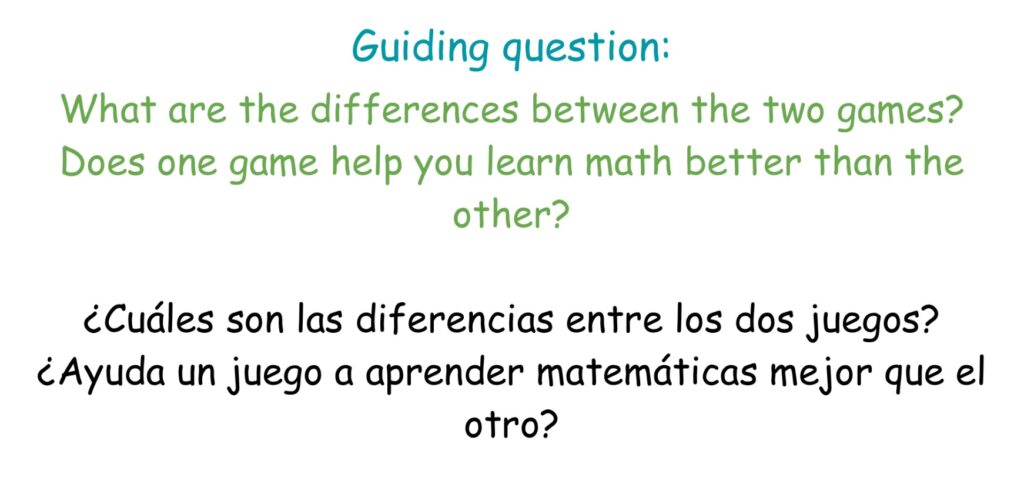
What are the differences between the two games? Does one game help you learn math better than the other?
Learning Activities
Materials
- Player pieces.
- White boards and dry erase markers.
- Game Card word problems.
- Game Card Printable (5 of each question).
- Game Boards (paper size).
- Game Descriptions (Spanish and English Versions Compiled).
Launch
To introduce the Guiding Question, I informed the students that they will be playing two games (described in Game Descriptions) and we will prepare by playing one round of the first game called “Feed the Monster: PotLUCK Party!”
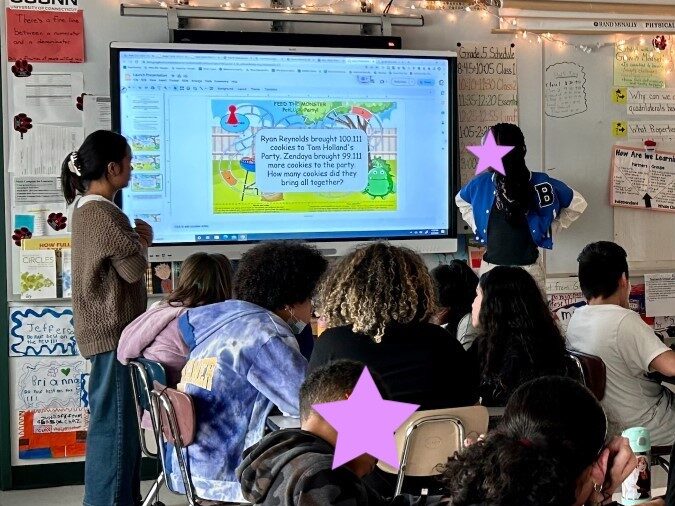
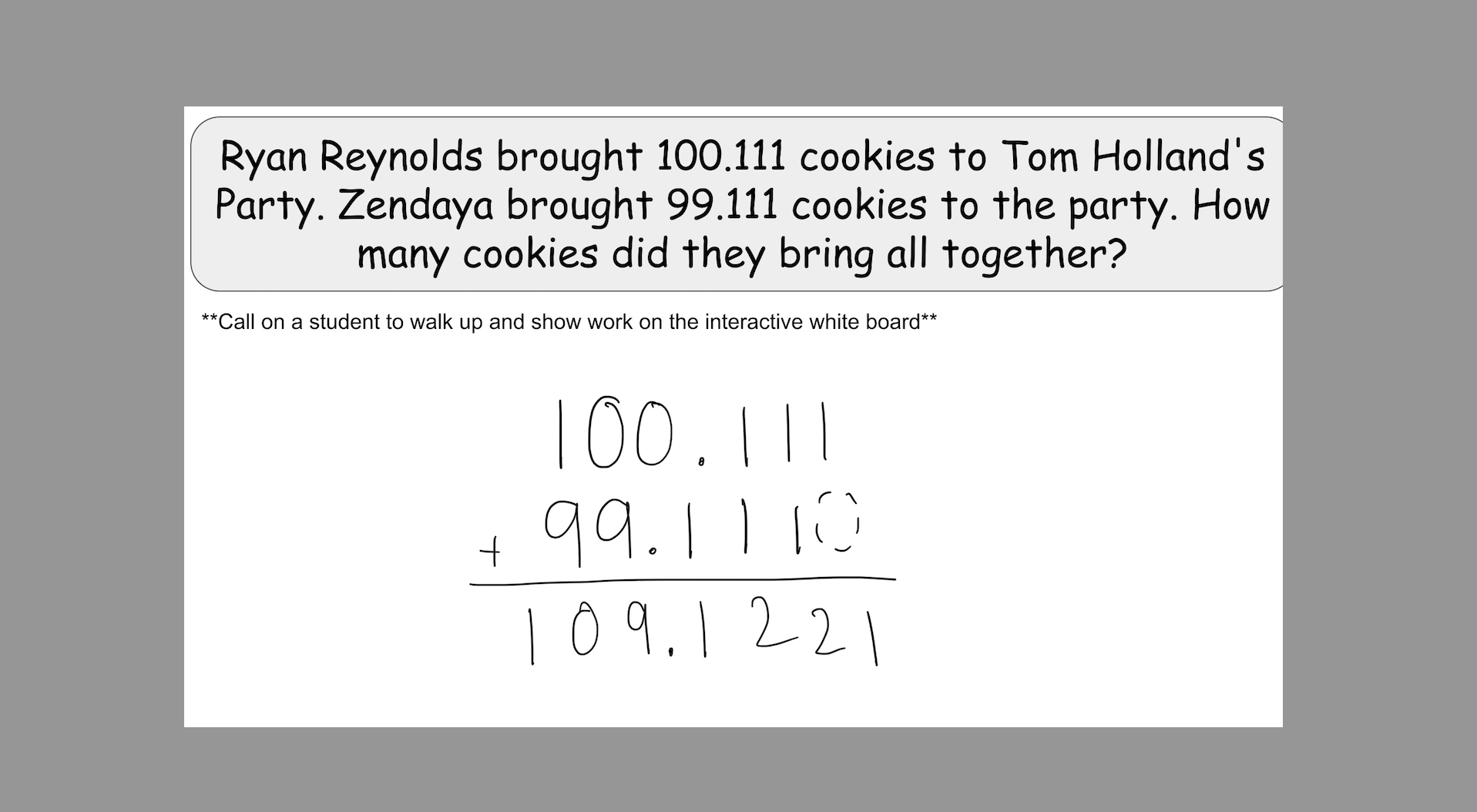
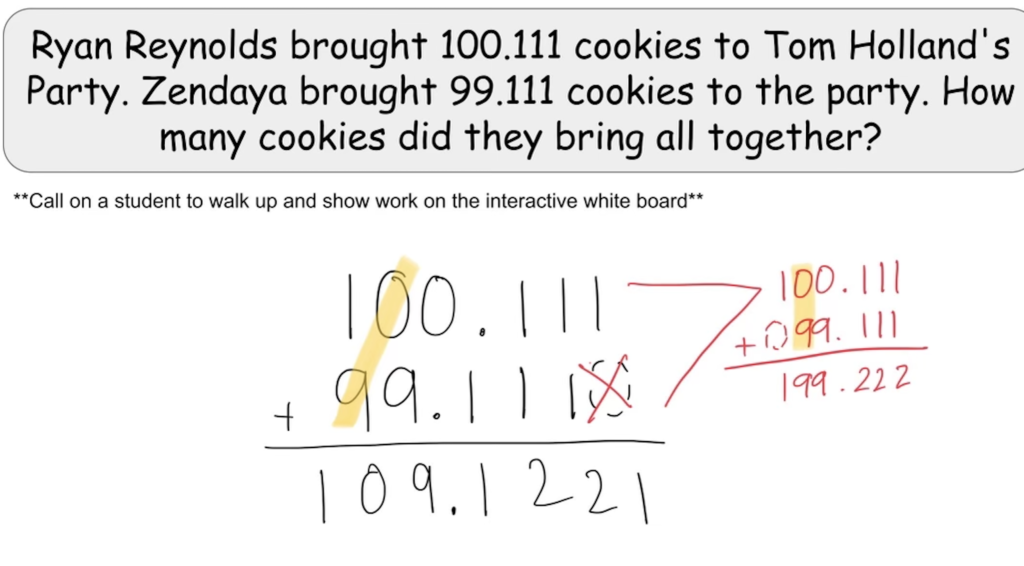
As shown in Video 1 above, we used the interactive smart-board to model the game through an editable Google Presentation. To play, I chose one student volunteer (in Figure 2.1) to work through the steps to solidify some understanding of how to play the game before it’s their own turn. During this, the student volunteer worked through an addition word problem on the smart-board while the students worked on the same problem at their desks with white boards (which had been passed out before the workshop officially started with the aid of student helpers). By doing so, we were able to simulate these steps:
- Step 5: Use your white board to work through the word problem on the game card. Then, explain your work to your group.
- Step 6: If your work is correct, move the number your dice landed on.
The class then discuss with their classmate at the smart-board to identify the error in the work (the student volunteer’s work is shown in Figure 2.2 and the discussion is shown in Video 2 below).
Additionally, the first slide of this Presentation (Figure 3) was also used to display the Guiding Question during the class for student reference as students were revisit the it at the end of the workshop.
To transition to Activity 1, I asked a couple student helpers to pass all the materials out (listed in Materials section). Both English and Spanish versions of the game descriptions and game cards were provided for the Emergent Bilingual students and their group-mates (who also help translate instructions); with both versions, the students were able to choose when they wanted to utilize each version.
Activity 1
To start, students were instructed to pick one person at their table to read the objectives and how to play. Then, they played the “Feed the Monster: PotLUCK Party!” game. During this time, I went around helping students in interpreting the instructions, asking how they knew how to solve the problem, and observing their strategies and work (and capturing it through pictures for later assessment).
To transition to Activity 2, I directed each group to have one student gather the papers (game board and game description) for the “PotLUCK Party” game to swap them for the papers for the second board game, “Feed the Monster: The Steaks are High!”
Activity 2
To preface, I emphasized that the strategy game is just like the first game but this time there is a different way to calculate points.
Again, students were instructed to pick one person at their table to read the objectives and how to play. Then, they played “Feed the Monster: The Steaks are High!” game. During this time, I went around helping students in interpreting the instructions, asking how they knew how to solve the problem, why they chose which game-card level and observing their strategies and work (and capturing it through pictures for later assessment).
Closing – Used for Assessment
To close off the class and to capture learning, students were to share: what were the differences between the two games? And does one game help you learn math better than the other? How so?
Assessment
To capture learning, I instructed students to use their white boards to write out their work and would take pictures of those white-boards throughout the class. Additionally, students will be checking each other’s work which may be captured in the recording.
Additionally, I asked students to share their answer to the Guiding Question in a whole class discussion and consequently loud enough for the camera to capture their individual answers.
Challenge Inequity
This lesson challenges inequity by giving the option for students to practice at their own level of knowledge. This allows them to be challenged at different levels of complexities and experience different strategy invoking games. Therefore, this ultimately provides a wider variety to cover a wider range of skill differences.
Moreover, there is importance in continuously acknowledging Emergent Bilingual students (in Lesson 2, students were referred to English Learners or EL’s) whether in a short workshop or a normal school year curriculum. Emergent Bilingual students must not be acknowledged when it is most convenient because, as stated in my Lesson 2 portfolio, many public schools are English-only classrooms (in both instruction and materials) which prevent these students from learning and fully participating along with their peers. Also, in the long-term, those students generationally lose their language and culture. Furthermore, math operations and language can be much more difficult as it is almost another language for Emergent Bilingual students to learn. For example, commas in American notation represent thousands while commas in Spanish notation represent what a decimal would represent in American notation (shown in Figure 6). Therefore, I will continue to provide Spanish translated copies so that those students can participate without their language being a barrier in learning and completing tasks.
Reflection
In orchestrating my final lesson, overall classroom management went very well. From reflecting on Lesson 2, I aimed to improve on having smoother transitions and to find efficient ways to refocus students. To do this, I planned on carrying out two main classroom management strategies: 1) using an attention grabber in the form of repeat-after-me claps and 2) having designated helpers to pass out materials throughout the workshop. In practice, these strategies turned out to be very helpful in not only classroom management but time management because facilitation goals were clear. With the same sentiment of sharing the lesson’s Guiding Question within the first five minutes of starting the workshop to establish a springboard for thinking, I shared those facilitation goals and strategies with the students before the workshop began to establish a collective goal for the whole classroom to work towards (shown in Video 3 below). With that, we were able to have very smooth and quick transitions. In comparison to Lesson 2, it took me at about 30 seconds to refocus students without an attention grabber, while in Lesson 3, the longest it took me to refocus students was 10 seconds after Activity 2, which can be also be seen in Video 3 below.
Additionally, there was a success in having more overall options and approaching inequities due to the continuation of having materials for Spanish speakers allowed the Emergent Bilingual students to participate in the games. One Emergent Bilingual student led their group in reading instructions to them and was the first to start the game. This is further discussed at the end of the reflection.
Moreover, there were a few unexpected occurrences regarding playing the board game. Firstly, there was unexpected behavior including students getting frustrated with each other and either shutting down or voicing their concerns. Some of these led to arguments and sometimes crying. Although I expected some competitiveness, I did not account for these behaviors during my preparation of the Lesson. To aid with this, I shared with the students that they can take a break and let the next person have their turn or they can try something one more time (like re-rolling the dice). Mr. Morin also helped me out with this occurrence and allowed a student to take a quick break outside of the classroom and talk to another staff member which helped the student come with a clearer mind. On top of that, students also just finished state testing and had just come back from lunch and recess which can be factors in their behavior. The reaction of being an understanding teacher and giving students the space to recoup or take a break to come back with a cleaner mind has shown to be effective which I can use for future teaching experiences.
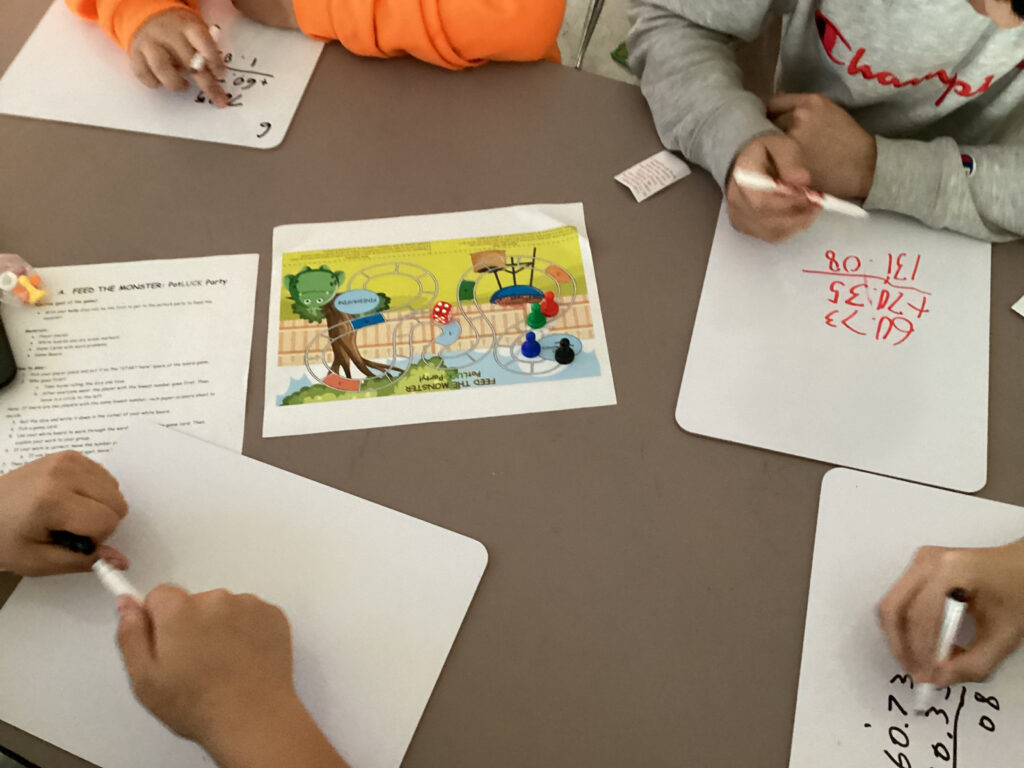

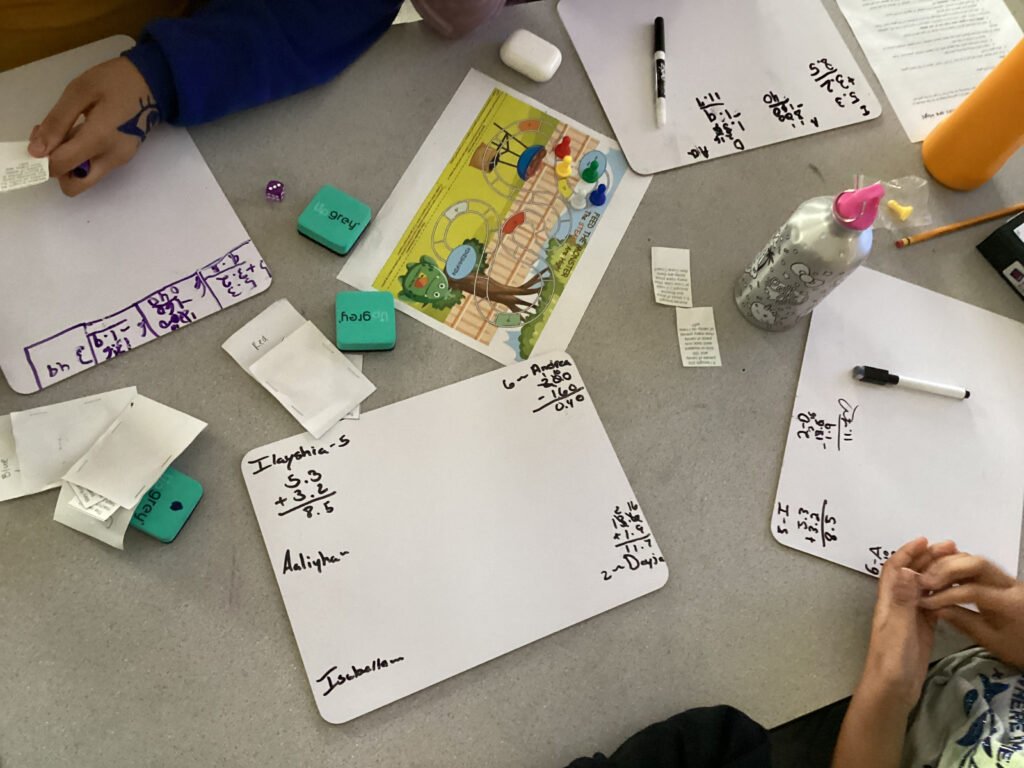
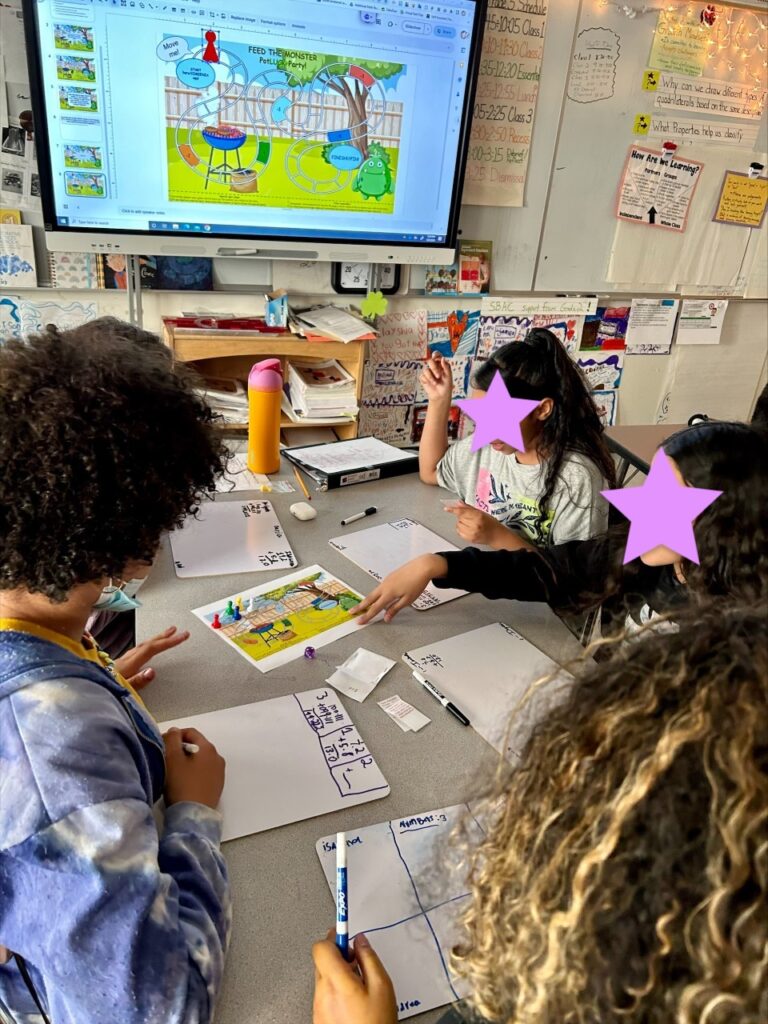
Secondly, the other unexpected occurrence involved multiple groups playing the game in a similar way that differed from the instructions given to them. In both instruction sheets, at the player’s turn, the player was to answer their game-card question and explain their work to the other students to evaluate if they got the answer right. If the answer was correct, the player would move up the game board. Instead, as shown in the picture above (Figure 4), each student individually worked on the same card each round while still observing and discussing the problem at the table. By doing so, students were able to identify any errors on spot and also there was more practice in solving and interpreting the game cards. During these discussions, students were able to share their own evaluations of the game cards by how they interpret certain words in the card to identify any math vocab and how they set up their equations. Although audio and video was not captured of the individual group’s interactions, this can be represented in the audio of Video 2 in the Launch section in which conversation went as follows:
[As Student B was working on the board]
Student A: “No, no. You don’t put the zero.”
Student B (student volunteer): “So what? It’s imaginary.”
[After Student B was done working]
Teacher to Student B: “Can you tell us how you solved this problem?”
Student B: “I did the problem by adding the two numbers that they provided because it [the problem] says ‘how many did they bring all together?'”
Teacher to the class: “Okay, so did we get a different or the same answer?”
Class collective: “Different.”
Teacher: *Calls on Student C to explain*
Student C: “So this is what I have: there’s no zero, you’re supposed to put the 9 underneath the zero.”
Therefore, when students had different thought processes, by doing the problem at the same time it gave space for knowledge mobility which allowed them to work out the errors.
From the occurrence described above, students were able to evaluate the word problems and persevere through obstacles (Objective 1) by, for example, doing their work together to share their differing interpretations of math vocabulary if errors were spotted. In hindsight, the students potentially worked on the problems at the same time because that was how it was modeled in the Launch. Still, it would have been effective to ask the groups why or if they liked the way we played the round in the Launch and why/if they didn’t like the way described in the instructions because it would have been evidence of students meeting the objective of evaluating the games.
As mentioned before, there was not clear enough audio to hear individual groups talking but through spending time with each group there was also evidence that students were able to grapple with evaluating the board game (Objective 1) in terms of identifying strategies and reasoning abstractly. During Activity 2, a student was sharing with me that during the strategy game, he wanted to choose a blue card because he wanted more points. Although this may seem intuitive, the student rolled a 6 and therefore could have chosen to do a question that was easier to him and still have moved up the board a good amount of times. But the student challenged himself and added another 3 points to move a total of 9 times—thus, strategically played the game.
Furthermore, in the closing activity, students were asked to answer the Guiding Question: “What were the differences between the two games? And does one game help you learn math better than the other? How so?” As shown in Video below, both students shared that were the main difference between the two games was the type of operations used within the game. The first student said that the first game was addition problems and the second game had subtraction problems. The second student added on to say that the first one was easier and the second one was harder. Furthermore, the first student shared that the second game helped him learn better because “The second one you had to subtract and add more numbers (referring to the strategy game’s new rule of gaining more moves if you answer a more complex problem). Therefore, students were able to evaluate the games to challenge themselves and judge their own learning which is evidence of achieving Objective 2.
Within the evidence of achievement described above, mathematical thinking and confusion was also shown through work on the white boards (shown in Figure 4) and again, discussions like in Video 2. With Video 2, Figure 2.2, and the description of the audio written above, one part of the student’s mathematical thinking was shown and voiced through the dotted zero and them sharing to a classmate that it is “imaginary.” As the other students were working on the problem during this time, many students spotted the error to which the student-volunteer showed confusion on where there was an error but through a student explaining his own thinking, the error and confusion was resolved. For that reason, the white boards and discussion was used to voice and show their mathematical thinking and potential confusion.
Therefore, with three workshops done, there has been room for improvement and personal growth in this teaching experience. For improvement, I can work on creating thought provoking questions or comments to have a deeper conversation about their mathematical thinking. For example, throughout the workshop I would ask students why they chose to do a certain math operation. Students usually answered with identifying math vocab. Still, I wanted to know more about their mathematical thinking but I got stuck when my questions guided them to essentially just re-read the question. To work on this in the future, I can ask students to visually show me and their peers what they are thinking on the whiteboards. I could have utilized the play-dough/dot method with place values from Lesson 2 to further organize and voice their thinking especially when the students were discussing different interpretations of the problems.
On that same note, in my closure activity, I asked students to compare their experience with the games and reflect on their own learning (answering the Guiding Question) to which there were two students who answered. From this, I did not prepare for only two students and again, was stuck to create more guiding questions to know more about their thinking and evaluation. To improve, in times where not many students participate, I can induce participation by asking questions where students can collectively share their stance without speaking on it. For example, for my closing activity, to have a better knowledge of student thinking, I could have said “raise your hand if you liked the first game better,” then “raise your hand if you liked the second game better.” Then, I would ask if anyone would be willing to explain why. This may cause more participation because the “raise your hand if…” activity would potentially allow students to feel better in sharing their answer if they know other students feel the same.
In terms of personal growth, I have found improvement on time and classroom management which has been described in the beginning of this reflection and was also a goal for improvement from Lesson 2. With that, I will continue to use attention grabbers, student helpers, and methods alike.
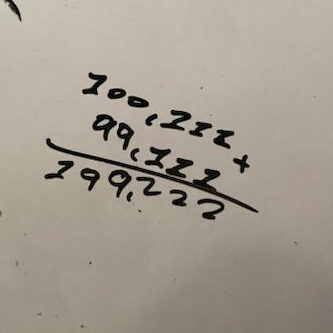
Alongside, with curriculum design, I made sure to continue to have space for students to succeed with multiple levels of knowledge and challenge. This was both for math and English proficiency. I used the same sentiment as Lesson 2 of having something in my “back pocket” where I can prepare different challenges for times I find fit but instead, the curriculum of Lesson 3 allowed the students to have their own judgment on when they want to challenge themselves. This allowed them to practice evaluative learning skills. I also want to note that the options of instructions and game cards in Spanish (and having one game board with both languages together) evidently allowed one Emergent Bilingual student to evaluate which material would allow them to best participate in learning. As mentioned before, one of the Emergent Bilingual students led their team in playing the game. This student read the instructions in English but also used game cards that were in Spanish. Likewise, displayed in Figure 6, this student used the column method (like in Figure 5) to answer game cards while also using Spanish mathematical notation. This was evidence of this Emergent Bilingual student able to be participate at a high capacity with their classmates
Sources
CT State Department of Education. “Grade 5: Fractions in Everyday Life.” CT.Gov – Connecticut’s Official State Website, https://portal.ct.gov/SDE/CT-Core-Standards/Materials-for-Teachers/Mathematics/Math-Units/Math/Grade-5-Fractions-in-Everyday-Life.
Freepik. “Cartoon Backyard Images – Free Download.” Freepik, https://www.freepik.com/free-photos-vectors/cartoon-backyard.
Kunstler, Julianna. Board Game Design. Lesson Plan. Visual Literacy. https://juliannakunstler.com/vislit_boardgame.html.
Math-Play. Decimals Board Game for Tablets and IPads. https://www.math-play.com/decimals-board-game/decimals-board-game_html5.html.
Printablee. 10 Best Free Printable Blank Board Games . https://www.printablee.com/post_free-printable-blank-board-games_259733/.