Context
March 31, 2023
On Day 2 of the “Feed the Monster” workshop, I returned to Mr. Morin’s fifth-grade mathematics class with 18 students in attendance at Expeditionary Learning Academy at Moylan School (ELAMS). Within this class, there are two students that understand best in Spanish and have two classmates that translate instructions for them. Accommodations provided in this workshop will be identified and discussed in the Challenging Inequity section.
In between Day 1 and 2 of this workshop, students were learning how to divide decimal numbers by multiples of 10 (using place value concepts), one-digit numbers, and two digit whole numbers in their regular math classes. This concept was built upon their supplementary knowledge of adding and subtracting decimals.
Furthermore, based on our first lesson, students showed excitement in sharing their cultural foods and celebrations to the class and in turn, students were engaged in filling the monster’s stomach with their choices of foods. Students successfully created a model fractioning out the stomach of the monster but did not complete creating and answering word problems.
That being said, the theme of cultural foods carried onto Lesson 2 with content changes that addresses what students missed in Lesson 1 and further connection to current topics in their mathematics class. Students’ tasks were centered on creating and answering word problems involving decimal problems instead of fractional problems. These word problems will then become a part of a board game students will create in Lesson 3.
Student Objectives
- Students will develop their own contextual meanings of “adding, subtracting,” and “dividing decimals” by modifying short equations into real-world math problems and answers. (5.NBT.B.7)
- Specifically, students will formulate an understanding of math and language by relating math operations to the setting of a potluck and amounts of food.
Objectives are derived from the Common Core State Standards (CCSS).
Guiding Question
How can we use numbers and language to convey the same idea?
- With this questions, students can assess which vocabulary means add, subtract, and/or divide to become math vocabulary.
Learning Activities
Materials:
The problem-designing activities required the following materials throughout the workshop:
- Online Decimal Board Game
- White board and dry erase markers
- Play-Doh
- “Math Vocab” Poster
- Card-stock/paper and pencils (Only utilized in Activity 1)
Launch
I introduced Lesson 2 by informing the students that they will be constructing their own decimal board game in the final lesson of our “Feed the Monster” workshop and to prepare for that, we will use this lesson to create some of our materials. To set the scene, I asked students to remind me of what we did in Lesson 1 so that I could connect it to Lesson 2’s goal of creating questions within the scenario of a potluck. These questions will be used as game cards in which students will solve potluck word-problems as part of the board-game.
To equip the students for making those materials, I launched the lesson by instructing the students to help me play an online Decimal Board Game to introduce the Guiding Question: “How can we use numbers and language to convey the same idea?” (Shown in Video 1) This virtual game will be similar to the board game we will design; a clip of playing this game is shown below (Video 2).
As seen in Video 2, the online game is played correctly answering a decimal equation that the game generates and if you correctly answer the decimal equation, you move a certain amount of spaces by rolling a virtual dice; the goal is to be the first to get to the end of the board-game path.
So, together we began playing the game with these provisions and the materials listed above to answer questions generated by the game:
- Each student will use their white board and Play-Doh to answer the question.
- I will call on one group to explain their work.
- Ask the class if there are other answers people came up with.
- Submit the answer on the online game.
- Together, create a real-life question using the operation and values generated and record it on the “Math Vocab” poster (Figure 1).
- Circle words and phrases that indicate the math operation.
- Then do steps 1-5 one more time.
Note: Since I introduced Play-Doh as a material without solidifying the concept of its use to model, and I wanted the students to use this as a way to show and work through a problem, I guided a few students with through hints of asking students about place value with hopes to balance out any frustration due to challenge to allow for thinking to occur.
Activity 1
To set up for Activity 1, I passed out card-stock to each student and directed them to make two half-folds to create four sections.
With what is listed in the Materials section above, each student was tasked to construct and prepare 3-4 decimal word problems similar to the class-created question shown on the Math Vocab Poster below.

To prepare for multiple levels of knowledge, I devised levels of math complexities. The 3-4 word problems must incorporate, at minimum, Math Level A and Level B (defined below). If a student was ready, the student would be challenged to incorporate a word problem using Level C (if needed, students can start by using whole numbers).
- Level A) Addition
- Example: My monster ate 12.6 in the beginning of the party then 34.8 at the end of the party. How much did they eat in all?
- Level B) Subtraction
- Example: My monster brought 40.6 chickens but then 17.4 fell on the floor, how much can they eat now?
- Level C) Division
- Example: After the party started, 20.1 turkeys were left, my monster ate half of that. How much did my monster eat?
During this time, I went around taking note of correct use of math vocabulary and added it to the math vocabulary poster. Additionally, Activity 1 involved the assessment; which is described below in the Assessment section.
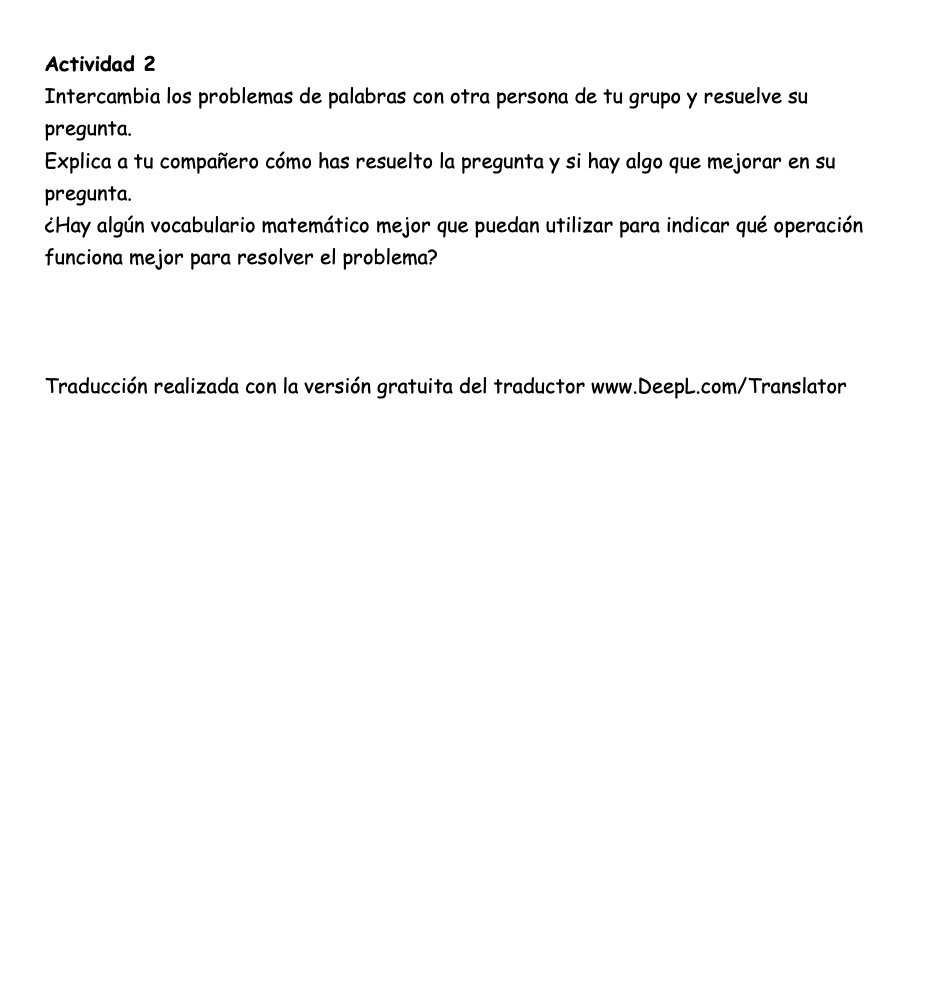
Activity 2 – Did not get to this, were to be used if time permitted.
Students would be directed to swap word problems with another person in your group and solve their question.
During this time, students would:
- Explain to your partner how you solved the question and if there is any improvement needed for their question.
- Ask: Is there another math vocab that they could use to hint which operation works best to solve the problem?
Closing
To wrap up the lesson, I asked the students the Guiding Question and instructed them to share out what math vocab they used and/or saw their peers use to create the Potluck word problems. We also reviewed the math vocab list (bottom of Figure 1) that had been in progress throughout class.
Assessment
During the work period of Activity 1, I instructed three students to share and explain how they would solve at least 1 question of the 3-4 problems to the camera using a white board and/or Play-Doh.
Moreover, each card-stock will be used to capture individuals’ progress in their thinking and application process of math vocabulary.

Challenging Inequity
This lesson challenges inequity by including Spanish written work to be used for the students to better understand the lesson and share their learning. Many public schools are English-only classrooms in instruction and materials causing those students to generationally lose their language and culture– which is, for many, an important part of their identity. By addressing the students who are non-English speakers, those students can participate fully without their language being a barrier in completing the task.
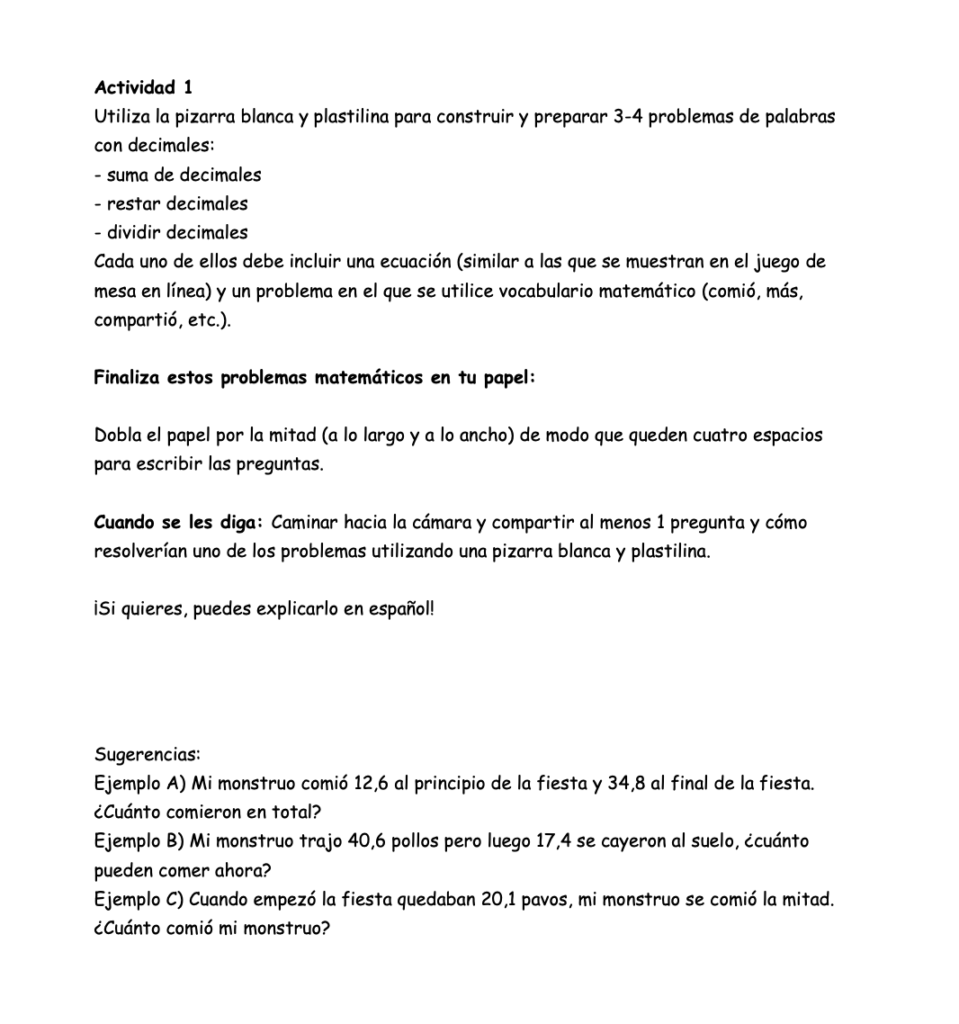
Therefore, to approach this inequity, for the students that can participate in Spanish, handouts of my instructions and math level examples for Activity 1 were provided (Figure 3). Furthermore, students were informed that their questions and answers can be written in Spanish. Also, for the assessment they may explain to the camera in Spanish.
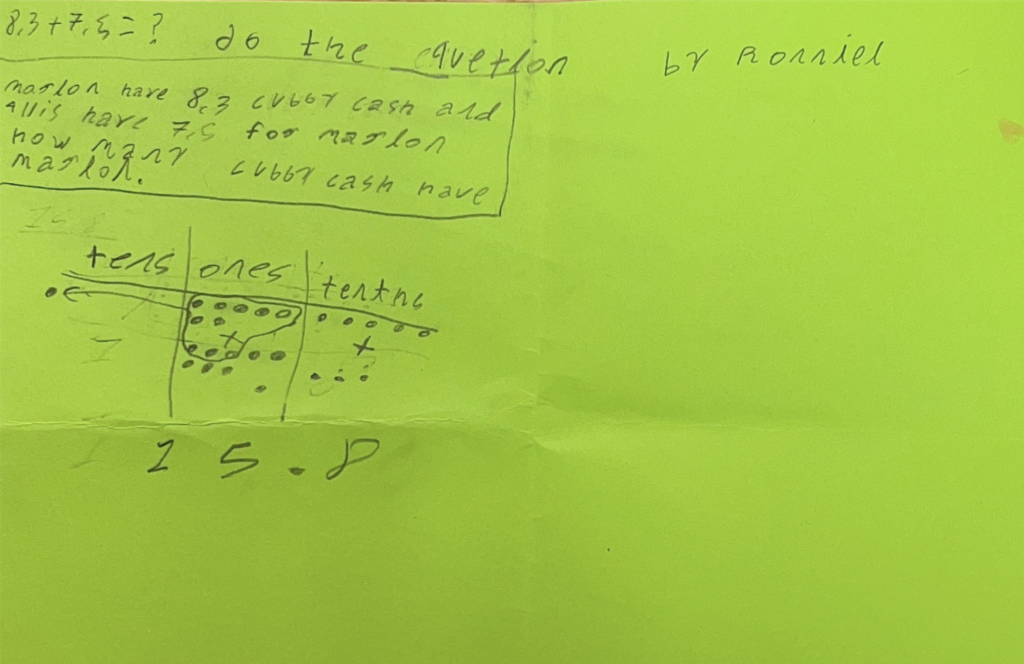
One student who is emerging bilingual has shown their participation in Video 5 and Figure 2.2.
Reflection
In conducting Lesson 2, working and adjusting with the student level of knowledge went well. The concept of “keep it in your back pocket”– it being student activities– was the strategy that allowed me to prepare and carry out strong groundwork for the lesson. Additionally, there was one main task at hand with multiple levels of complexity to work off of. Specifically, the launch activity was used to create word problems together and Activity 1 was used to create and solve their own word problem. Unlike in Lesson 1, there was a launch, two activities, and an assessment– all with different activity focuses and required a certain level of knowledge to successfully carry out and complete. The focussed task and the activities prepared allowed for more time to work with any unexpected challenges.
One of those unexpected challenges included the lack of attention, which was not a notable interruption of the workshop in Lesson 1. Shown in Video 6, it took about almost 30 seconds to get everybody’s full attention, and in addition, there was a point in which Mr. Morin had to chime in with clapping to get the students to get the classroom refocused when I was giving instructions; this refocus only took about 5 seconds. Alongside, when the materials were passed out, I gave each table (of 2-4 students) two cans of Play-Doh which one can would have been more than enough to use as a model for a table of 4 students. Due to this, in one instance, a student chose to use the Play-Doh to create small figures of the foods that were being used in the word problems. Although this student did attempt to create the values used in the word problems, there would be a disproportionate amount of time used to create the small figures and create and solve multiple word problems. In reaction to this conflict, during instruction, I asked students to put the dough back into their cans. This ended up taking more time which could have been used for instruction and consequently, more work time. With that in mind and seeing how the activity played out, it would have been beneficial to pass out the Play-Doh after all instructions were explained so that students would have an easier time focusing on the teacher. Additionally, especially when the activity involved group work, I would pass out a can or less of Play-Doh to further prevent distraction. Finally, another strategy that could have been used is utilizing strategies that I saw Mr. Morin use during this lesson. One being using positive reinforcement instead of negative reinforcement (when I asked students to put away their materials); so, instead I would say things like, “I like how this group is doing ___.” Another being a repeat-after-me clap to redirect students, as shown in Video 6.
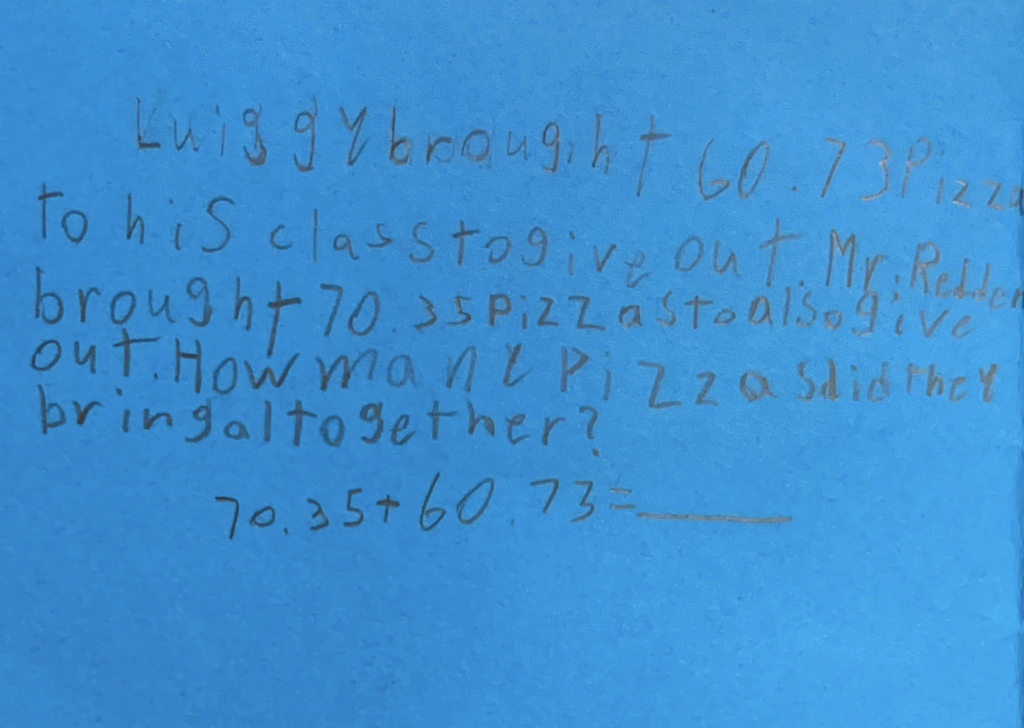
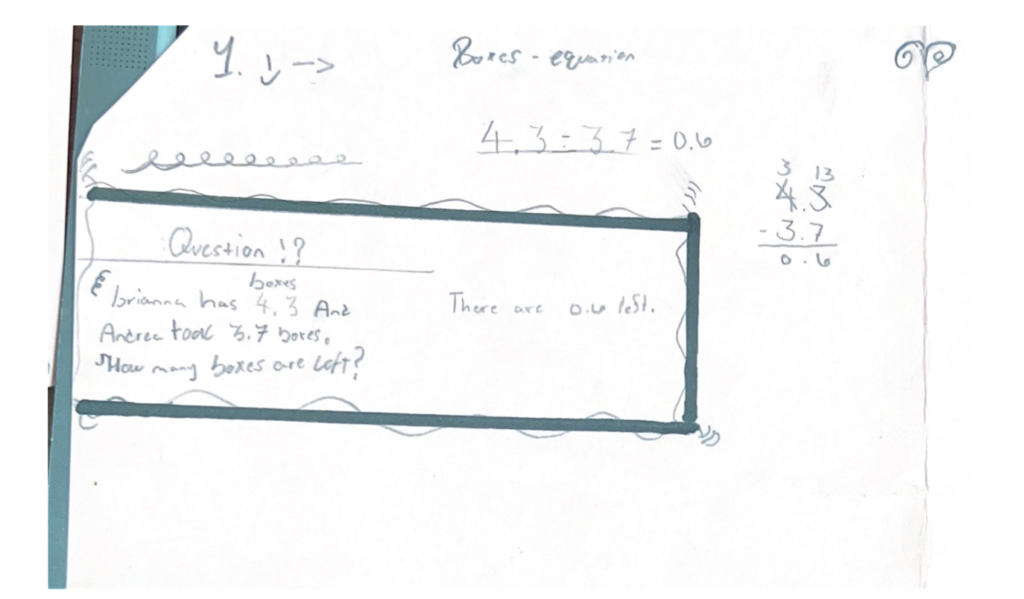
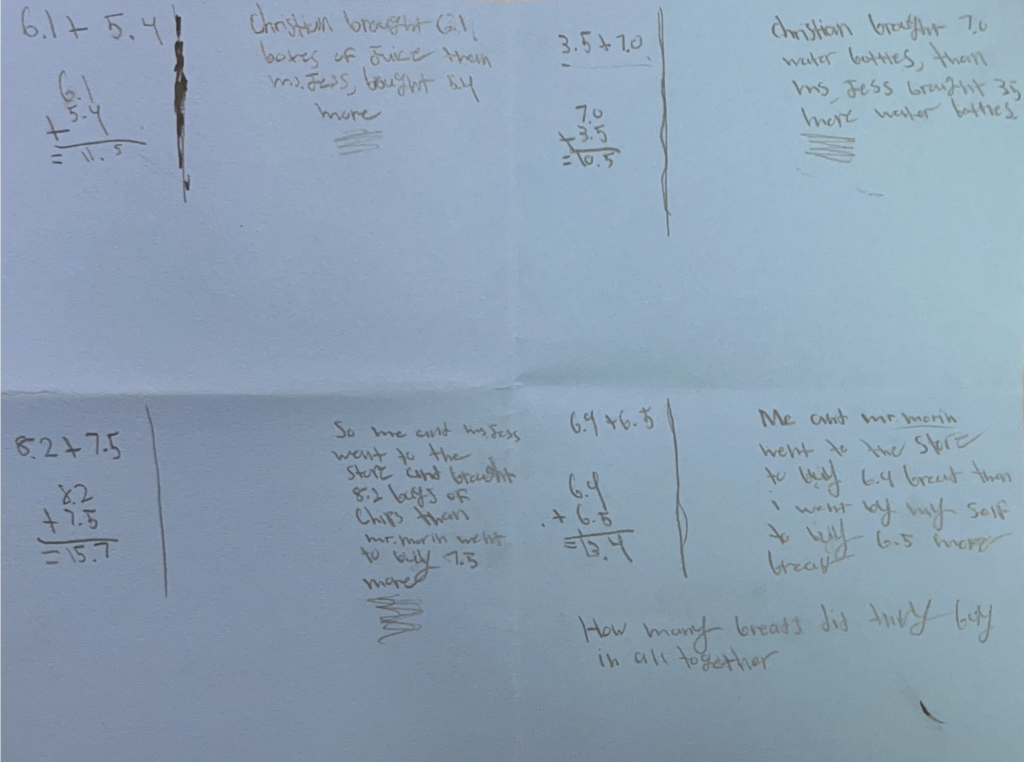
Nonetheless, the goal of using the Play-Doh to model and show work for the word problems was achieved. To make sense of the values, students were able to find their own strategy to use their Play-Doh and white board together to answer the question. At first, as shown in Video 7, almost all students did not use any Play-Doh in the first problem, although some did try, during the Launch but when the first group was called to share their answer and how they solved it during the Launch activity, many students in other groups were able to use that strategy to work on the proceeding activities. This knowledge mobility allowed for students to additionally grasp onto adding decimal problems as this provided students a solid strategy to explain, write-out, and answer decimal word problems. The two main strategies captured in this lesson were the column method and the place value model (with Play-Doh) method; these different strategies can be seen in Video 3-5 and Figure 2.
Moreover, as mentioned above, in the Launch activity students were able to thoroughly understand how to add two decimal values together. Afterwards, we brainstormed addition words that they already knew and we were able to model one addition word problem together. As shown in the Figures 2 and 4 and Videos 3-5, students were able to partially meet the objective for this lesson as students were able to use the model problem and the guiding question to create their own word problems with multiple scenarios, values, and math vocab for addition, subtraction, but not division. One student, shown in Figure 4 below, even underlined their main addition vocab which further showed successful identification and contextualization of math equations and vocabulary for addition operations.
As mentioned before, I devised levels of math complexity, and since I saw that many students were able to create and solve their own addition word problem without directly using the model question, I decided to move up one level in math complexity– to subtraction. To introduce this, I asked students to shout-out vocabulary words that would signal to us that subtraction would be used to solve the problem (stemming from the guiding question). At this point, (shown in Video 8) there was noticeable confusion as students were not able to shout-out answers as quickly as they did for addition vocab. Thus, showing me that the students had a difficulty with grappling with my question. To help them, I asked them to start with thinking about words we used for adding, to possibly think about antonyms, then also asking them to simply think about the definition of subtraction. From this, students were able to better grapple with my beginning question, as I got a couple more shout-outs like “less (than)” and “take away.” One response that was a great surprise was a student who said “How much more than 7 than 5,” which was an example that was more complex than others and were less directly correlated to subtracting.
Therefore, as this is my second lesson taught, there is room for improvement and also growth from lesson 1. Firstly, to improve my lesson, I would identify which hands-on materials should be passed out before or after instruction. By doing so, there would be less time on refocusing students and there would be smoother transitions between activities. Additionally, another strategy to create smoother transitions is to utilize attention-grabbers that are already set and understood in the classroom. This would easily allow for more work time and time for questions. With that, I noticed that when giving instruction or when talking to the whole class, I did not stop and ask if there was any confusion or questions that needed to be addressed. By remembering to take a second and ask students if they had trouble understanding, there would be better flow and grasp for what students were meant to learn. Finally, from lesson one, since I had levels of math complexity and an extra activity “in my back pocket” I was able to manage time better and was also prepared for a variety of skills. On that same sentiment, I was prepared for including non-English students by providing instructions in Spanish along with hints when they were needed.
Sources
“Decimals Board Game.” https://www.math-play.com/decimals-board-game/decimals-board-game_html5.html.
Google Docs. “2223 Grade 5 Scope and Sequence.Pdf.” https://drive.google.com/file/d/1kAmSHAYT2CpIgAo4jTPYtuJH7xXS1uei/view?usp=sharing&usp=embed_facebook.
“Great Minds | Eureka Math2.” https://greatminds.org/eurekamathsquared.