Context
March 10, 2023
On Day 1 of the “Feed the Monster” workshop, I visited Mr. Morin’s fifth-grade mathematics class with 16 students in attendance at Expeditionary Learning Academy at Moylan School (ELAMS). During my initial observational visit on February 9, I sat in on their regular math session at which students were working on place values and decimal operations including adding and subtracting. Notably, students were learning place values of decimals through fractions. With this, students solidified their fraction concept skills in Lesson 1 (explained further in the Activities section).
Furthermore, ELAMS has a saying that their student body is a “Crew, not passengers” to foster a community of leaders. With this, everyone in the ELAMS team are crew members. The ELAMS crew is majority students of color, and most dominantly Hispanic– which is reflected in Mr. Morin’s classroom. Additionally, on Day 1 I met 3 emergent bilingual students who were Spanish speaking and had one of their classmates translate my instructions. Therefore, the crew has multiple cultural backgrounds that can easily be used to make this lesson engaging and relevant to the students. Through this, the students will be meeting a new crew member, a very hungry monster, to elevate their mathematical skills and share their favorite (cultural) foods from home.
Student Objectives
- Students will produce percentages by using fraction operations, including addition/subtraction and multiplication/division, to create multi-part word problems. (MP.1)
- Students will compare values using inequality symbols and language to measure fractions against a portioned model. (MP.5)
Both objectives additionally involve MP.4.
Objectives are derived from the Connecticut Core Standards (CCS).
Guiding Question
How can we use our fraction and operations skills to feed the monster enough food?
- With this question, students will first create fractional values (food for the monsters) that adds up to a whole (the monsters’ full stomach), then produce real-world inequality math questions to make comparisons against their fractional values they established.
Learning Activities
Multiple learning activities took place as described below, most of which required students to work vertically with their peers.
Launch
To introduce the guiding question, I asked students to imagine that they are at a family celebration and think about the foods they eat at those celebrations (Video 1). Then after giving them a moment to think, I wanted them to pretend that a hungry monster is joining the family gathering and we need to show what foods they can eat. Since the monster knows nothing about human dishes, I instructed the students to create a “menu” by writing at least one food that they had imagined at their celebration to a classroom poster (Figure 1).
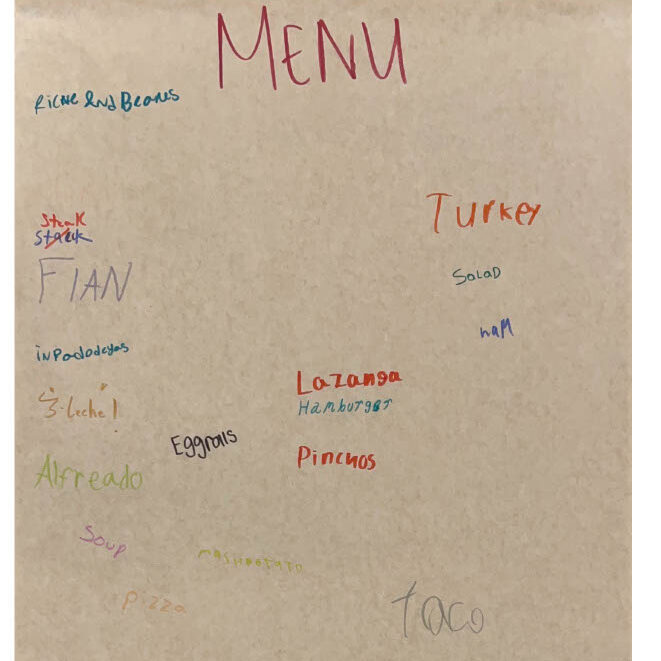
Then, to close off instruction, I make it known that we will use this list/menu and our fraction skills to make sure we can feed their monster enough food at the family gathering (taken from the Guiding Question).
Group Work: Activity 1
Students were then randomly separated into 4 groups of 4 students. These groups had the task to fill the monster’s stomach with foods from the menu and represent this by creating a fractioned model with a legend to indicate which colors/symbols on the model represent which foods.
To do so each group must agree upon 5 foods/dishes from our co-created menu that they think their monster would enjoy. They would be given a poster, a white board, markers (normal and dry erase), and a 10×10 grid monster outline to complete this activity.
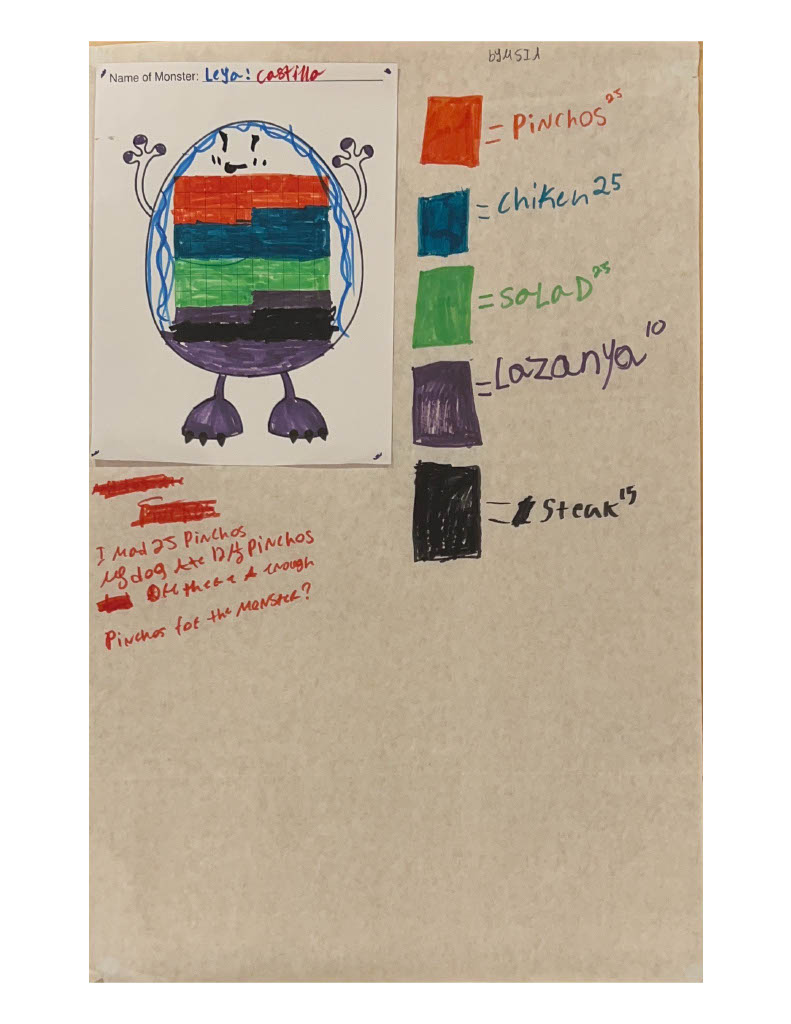
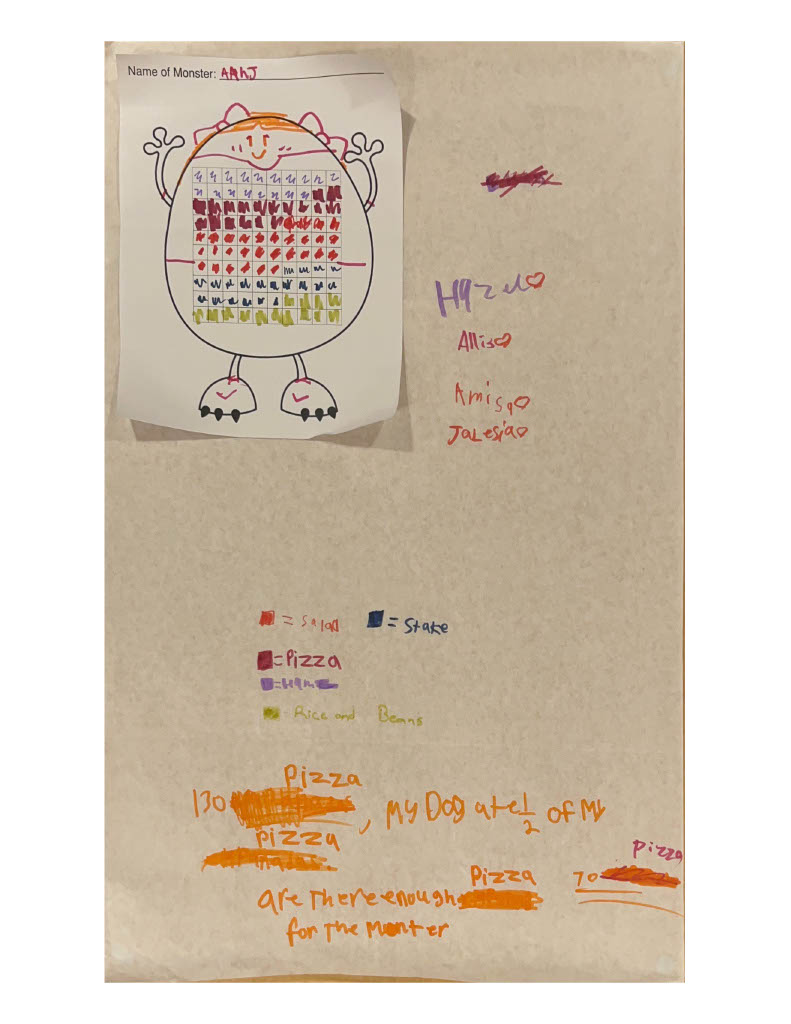
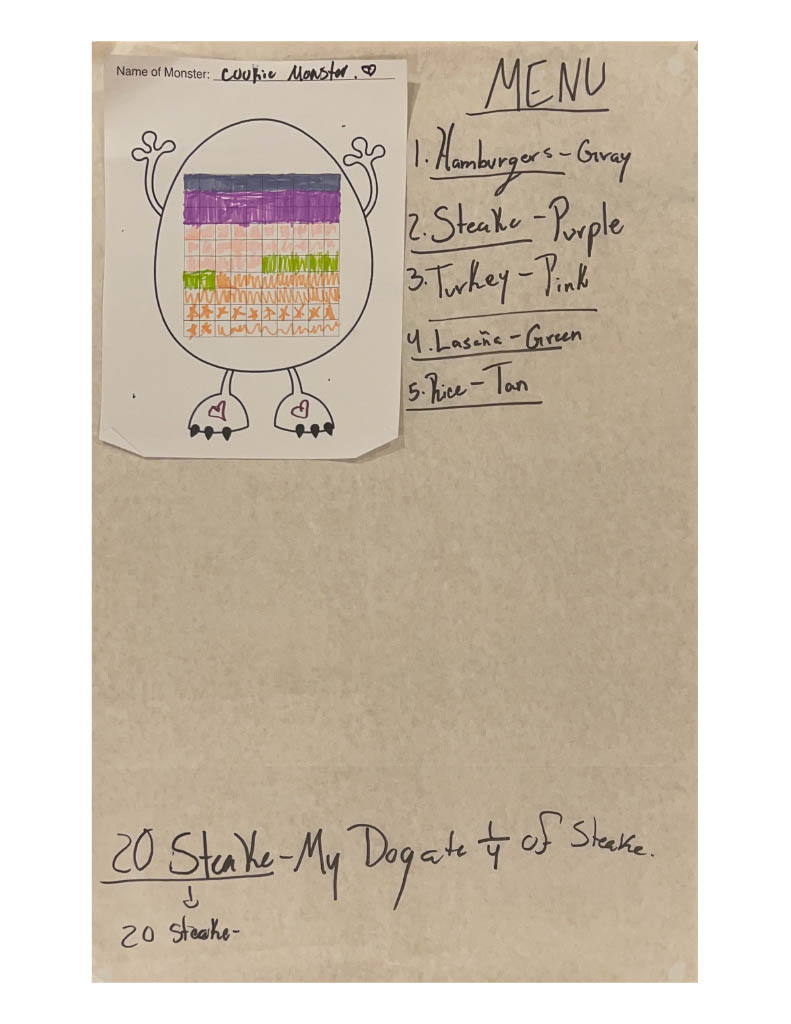
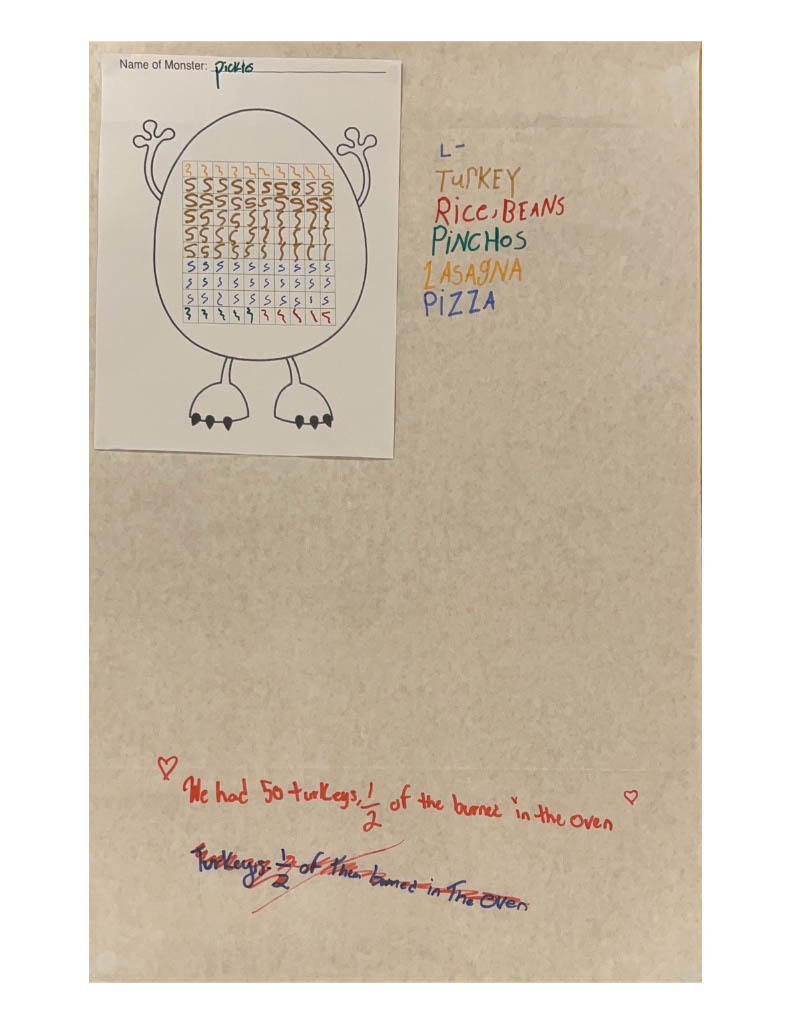
Additionally, to highlight the importance of the legend, I ask the students to share what a legend means (Video 2). This has significance because without this piece, there would be no way for our peers to correctly read their models.
Video 2: Clarification and emphasis on the model’s legend.
Group Work: Activity 2
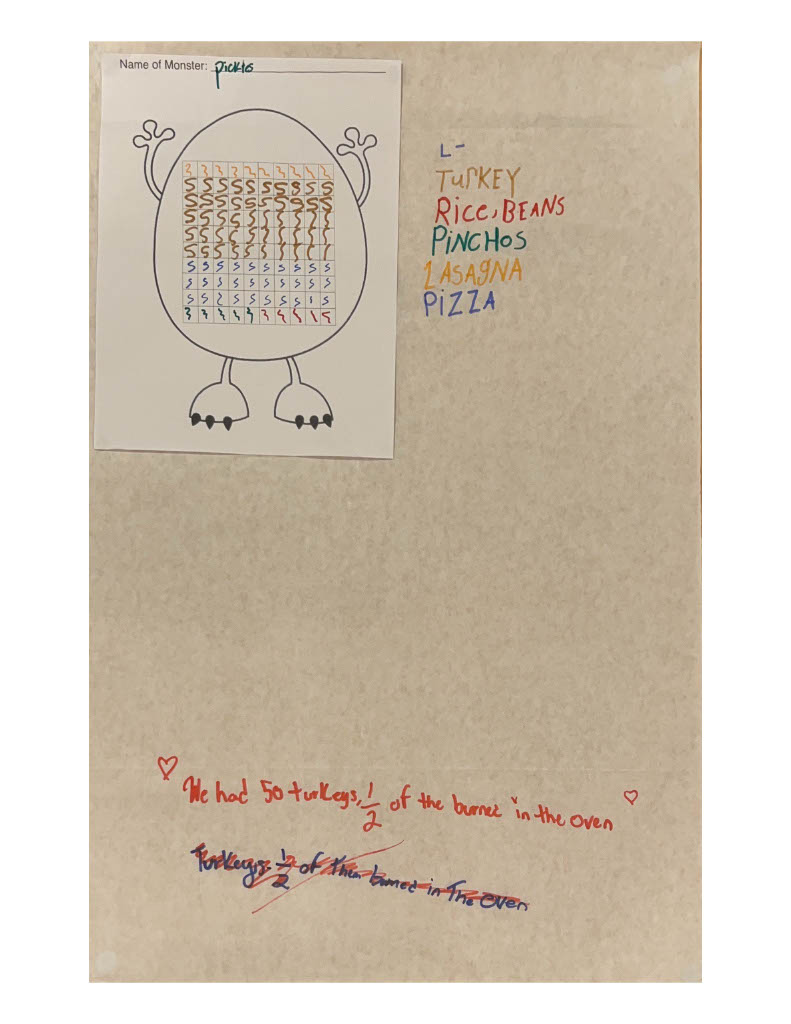
In these same groups, students had the task to create a real-world word problem that involves using fractionating a whole (ex. My grandma and I made 130 empanadas for our cookout but then ⅓ of them got eaten by our dog!) in the question set-up and comparisons (<,>,=) in question (Is this enough to fill up our monster?). Students utilize their model, fraction operations, and their imagination to produce these questions (Figure 3).
Assessment
In the last ten minutes of the lesson, students were directed to sit at their tables and were then given an exit-slip. Students were instructed to write on their own exit-slip but are permitted to discuss the questions at their tables.
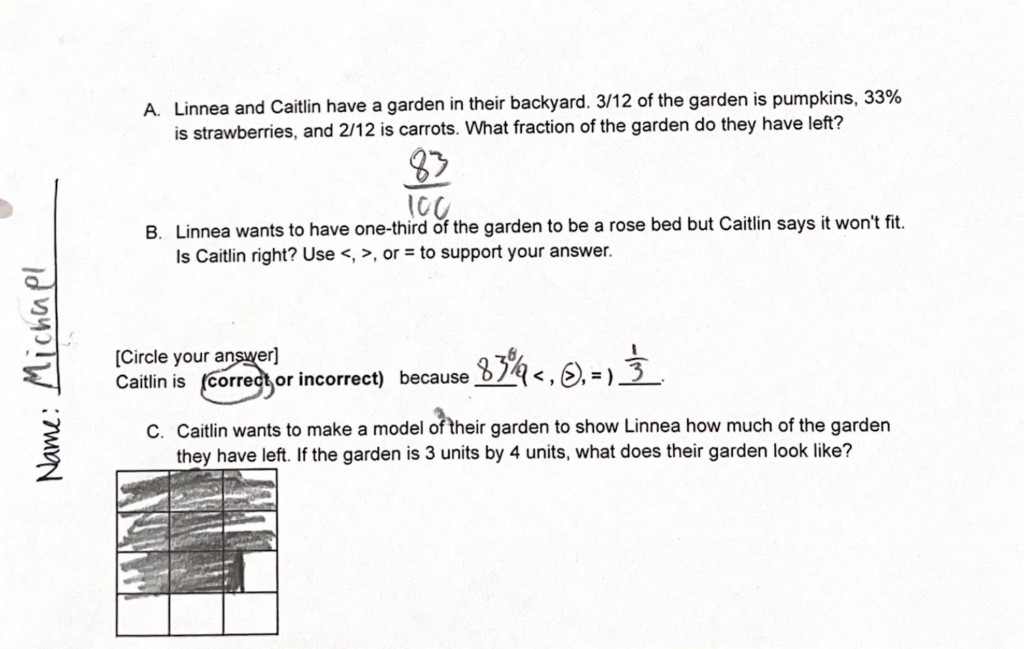
With this, I am more focused on their written attempts and listening in on student discussion and student work showing the exit slips. I will be able to know where the students are at. Additionally, time was used to prioritize one-on-one teacher discussion for me to give in-person feedback as they work on these exit-slips.
Challenging Inequity
This lesson challenges inequity by addressing the disconnect with American mainstream schools with home culture and environment. Due to America’s history of forced assimilation of immigrants, openly embracing and using cultural ideas and concepts (like cultural celebrations and foods) in school does not occur. This can cause students to hide their culture in school when, in truth, they can benefit from using what they talk about at home to connect with their school lesson to better grasp what they are learning and have an overall better connectedness within the classroom. Therefore, this lesson bridges the student’s school and home environment and welcomes culture into the classroom.
Reflection
During this first lesson, the Launch and Group Activity 1 went very well. Students were excited to talk about their favorite foods and dishes as many raised their hand to share to the class what they wrote down on our menu. On that note, there was also no issue in overall student response during the launch. The high engagement in the beginning transferred into Activity 1 in which students completed a fraction/portion model of foods for the hungry monster and including color coding and a legend (Examples in Figure 2).
With this first activity (Activity 1), it was unexpected that all students would immediately grasp that with context that we want the hungry monster to be fed enough food at our celebration, so 100% of the stomach should be color coded, or to put in plainly, the monster should be full. I asked students how they decided on their individual numbers and one group shared that they added up all their numbers and got 100. This was enough information to know that the students thought critically to use simple algebra to create their own set of numbers to equal 100 because every number was up to their own accord. Although, in hindsight, I would like to hear directly from the group what steps and strategies they used to produce their values without any initial number given to them. Be that as it may, in the Video 3 you can hear students from the same group that I had talked to about their values, explain to one another how to fill up the monster’s stomach.
Secondly, with Activity 2, I originally planned for the students to create a multi-part problem to make comparisons against their portioned model and additionally have each group move to another group’s station and answer the question. However, when this activity was introduced, students did not immediately grasp the task as they did in the beginning.
In Video 4, one student shares that they do not understand the task at hand from listening to my instruction. Due to this, and the limited time left in the session, I decided to instruct this activity by making an example question on the board for the students to better understand the second task.
Example Question: “My mom and I made 130 empanadas for the party. Then my dog ate 1/2 of the empanadas! Is there enough left to feed my monster?”
After this, I observed that one group of students were able to grapple creating a one-part word problem involving value inequality and fraction operations. This mathematical thinking was shown as the group came up with a unique real-world scenario that results in a fractional decrease to a starting value. Specifically, the mathematical operation involved multiplying a whole number/starting value, by a fractional value. However, this was not the same for all students. I saw that many students ended up using my example as a “fill-in-the-blank” formula in which students only switched out the values and type of food to create their scenario; thus, showing the example problem did not encourage thinking in this process.
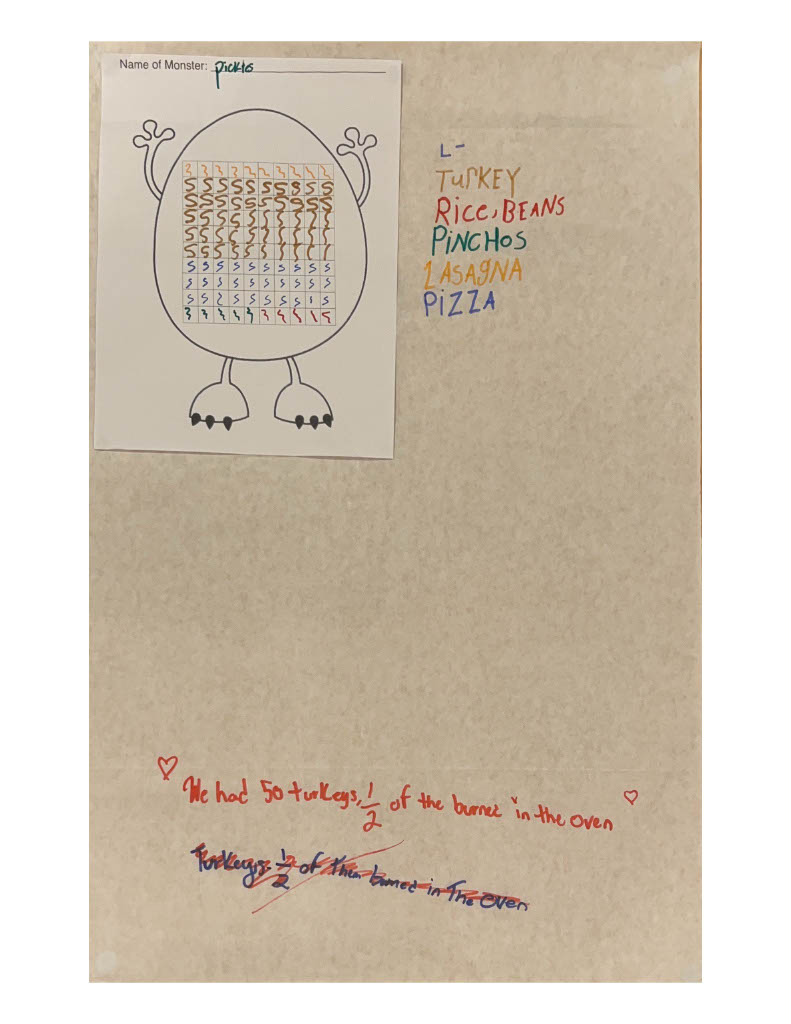
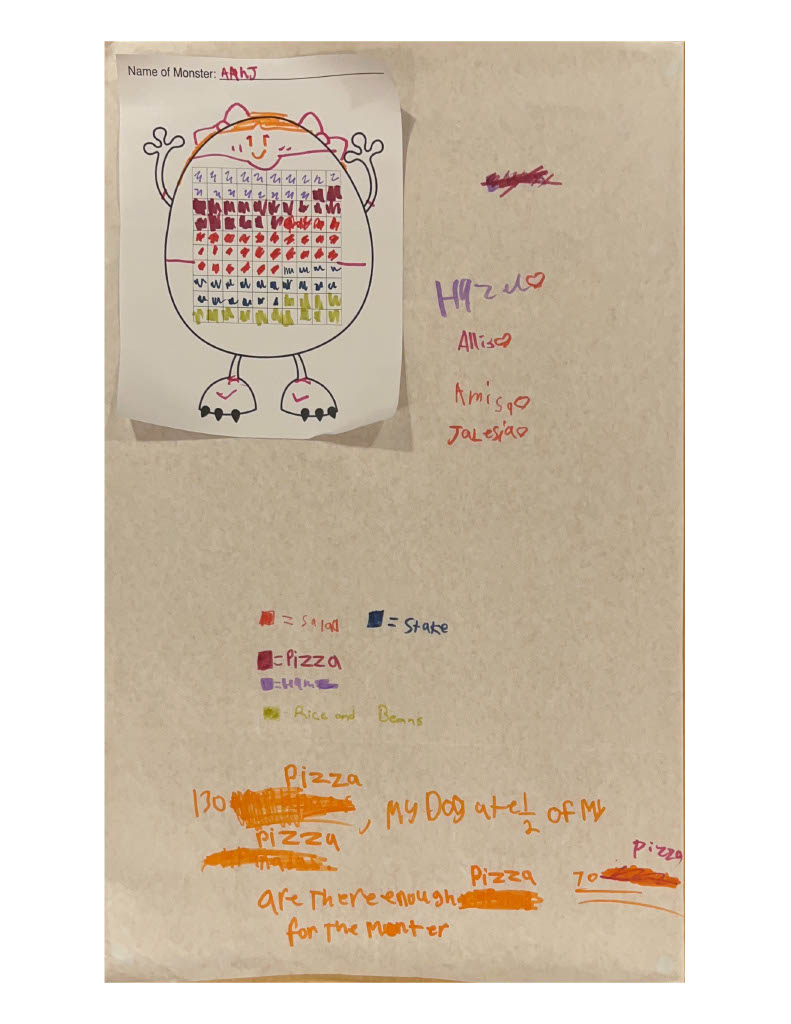
Activity 2 was meant to set students up to successfully attempt or complete an exit-slip for assessment, but due to the time and judgment of their level of knowledge, there was not enough time to sufficiently explain and complete the original Activity 2 plan so that they can create and answer a multi-step problem.
Furthermore, I did not expect to instruct a group that understood best in Spanish. Due to this, I adjusted time for them to finish so that all students could be on the same page before moving onto the next instructional segment/activity. I additionally, spent more one on one time with that group to attempt to make the activity instructions as clear as possible. In turn, with the consciousness of that group, I lost more time for proceeding activities.
Therefore, to improve my lesson I must be more cognizant of time so that there is more time to address any confusion for proceeding tasks. In the future, I will make less topic-changing activities that involve a large switch in focus. For example, for this lesson I had a Launch activity, then a model-making activity, then problem-making activity without smooth transitions or time for giving enough illustration for what I wanted for them to correctly complete the last activity. Additionally, to do this, I must also plan out different ways to explain higher-order thinking tasks to the class as writing on paper (addressing adults) does not easily transfer to speaking to fifth grade students. Moreover, the assessment additionally did not work as Activity 2 did not provide a foundation for students to successfully apply their mathematical skills to the multi-value and multi-part questions. Thus, from this first lesson, I have learned that although half of the lesson was not a success story, with clearer knowledge of the students level of knowledge and better preparing instructions that can make sense to fifth graders (which will also will aid with doing activities in a timely manner as all students will be able understand the task at hand), higher-level thinking can be carried out if taken at focused steps to solidify before reaching an increased difficulty.